Franz Josef Glacier Guides - Regeneration through Collaboration
January 2026
When Franz Josef Glacier Guides (FJGG) looked at the future of their business, one thing was clear: the wellbeing of their operation is inseparable from the wellbeing of the place they call home. But like many tourism operators in Aotearoa, they faced a simple, stubborn challenge — their work is deeply weather‑dependent. This meant staff downtime, fluctuating workloads, and an ongoing desire to keep people meaningfully connected to the kaupapa of the region.
Rather than seeing that downtime as a problem, FJGG reframed it as an opportunity: How might we give kaimahi purposeful, values‑aligned work that strengthens the places and communities we rely on?
That question became the seed of two major regenerative initiatives: the Ōkārito Plant Project and Project Ribbonwood.
Turning an Idea Into a Collective Movement
The journey did not begin with a strategic plan or a big grant — it began with a conversation. A chance kōrero with another local operator sparked a realisation that they didn’t need to do this alone. From there, FJGG reached out to like-minded business, iwi partners, community member and conservation groups. Eventually a growing network of tourism operators were keen to get involved.
The process was simple but powerful: pick up the phone, invite others in, co‑design the project, and build shared ownership from day one. What began as a small idea has grown into a regional movement.
Ōkārito Plant Project: Restoring the Ecological Heart of South Westland
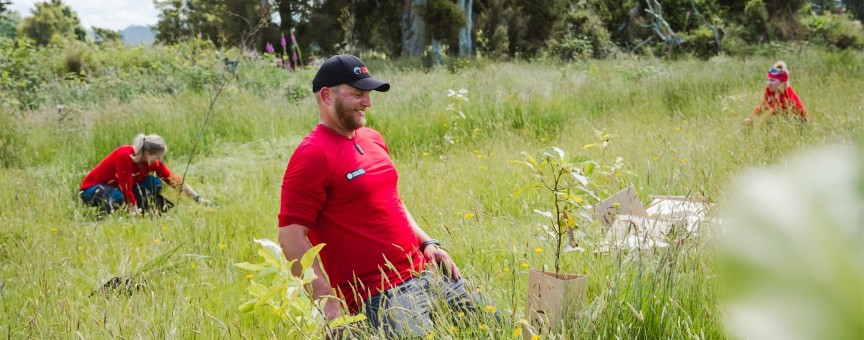
The Ōkārito Plant Project focuses on restoring native habitat at scale — something that would traditionally sit outside the remit of a tourism business, but FJGG saw the opportunity for true partnership. Through regular planting days and hands‑on mahi, kaimahi contribute to:
- restoring biodiversity by planting eco‑sourced native trees,
- stabilising waterways and improving environmental health,
- reconnecting forest and wetland ecosystems,
- strengthening cultural ties through planting significant local species
The project has become a magnet for community involvement — volunteers, local businesses, conservation organisations and iwi working side by side.
Project Ribbonwood: Protecting the Wildlife That Shapes the Visitor Experience
Alongside the planting efforts, FJGG is an active partner in Predator Free South Westland (Project Ribbonwood). This initiative focuses on reducing predator numbers and protecting the native species that make the glacier region so remarkable — including kiwi, whio, and kea.
Entering this space brought its own challenges. Predator control requires technical capability, specialist knowledge, and careful planning. FJGG found their confidence by connecting with others already doing the work — leaning into the collective wisdom that has always driven conservation success in Aotearoa.
What’s Been Achieved So Far
The impact of these projects reaches far beyond environmental outcomes.
For people:
- Kaimahi have developed deeper connection to the whenua and confidence in sharing regenerative stories with manuhiri.
- Four part‑time roles have been created and more than 2,100 volunteer hours contributed.
- Staff pride and retention have grown as team members step into leadership roles and drive parts of the project themselves.
For the environment:
- Over 20,000 eco‑sourced native plants are now in the ground.
- Habitat corridors are forming, waterways are stabilising, and native species are better protected.
- Stronger alignment is forming between tourism and conservation, making it easier to embed tiaki in every visitor experience.
For the economy:
- 18 businesses are actively involved, participating in 23 shared events.
- The work has generated over $70,000 in local revenue, demonstrating that conservation can create economic value, not compete with it.
- New partnerships, shared products, and collaborative visitor experiences are emerging across the region.
- Businesses are exploring new joint experiences and storytelling aligned with regeneration.
Perhaps most importantly, the mindset has shifted. Tourism operators are no longer acting in isolation — they are “jumping on the waka” together, recognising that regeneration is a collective effort.
The Challenges Behind the Scenes
While the results are inspiring, the journey wasn’t without its challenges.
There were moments early on when the project felt overwhelming — too big, too technical, too demanding for a busy tourism business.
The turning point came when they realised they didn’t need to be experts — they simply needed to collaborate. As interest grew, a new challenge emerged: managing demand, keeping everyone engaged, and ensuring the kaupapa stayed strong. Flexibility, communication, and trust proved essential.
A Model for Regenerative Tourism in Aotearoa
The story of the Ōkārito Plant Project and Project Ribbonwood is a powerful example of what’s possible when tourism operators turn intent into action. It shows that regeneration doesn’t require perfection or grand gestures — it starts with a conversation, a willingness to collaborate, and a commitment to give back to the places that give us so much.
FJGG’s work shows that when tourism businesses lead with purpose — and do so collectively — the impact reaches far beyond planting days or predator lines. It regenerates the environment, uplifts people, strengthens culture, and builds a resilient future for the region.
Visit their website for more information.